See · 02 · Field manual · PDF
The Systems Field Manual
How to draw any situation as a system, and find the one change worth making.
Six questions, eleven concepts, one way of drawing. Each idea comes as a sentence, a diagram, a worked example and an exercise, plus how people who build software systems think about the same thing.
PDF only: instant download, 66 A5 pages, no printed copy. Taxes calculated at checkout.
Not useful? Full refund within 14 days, no questions asked.
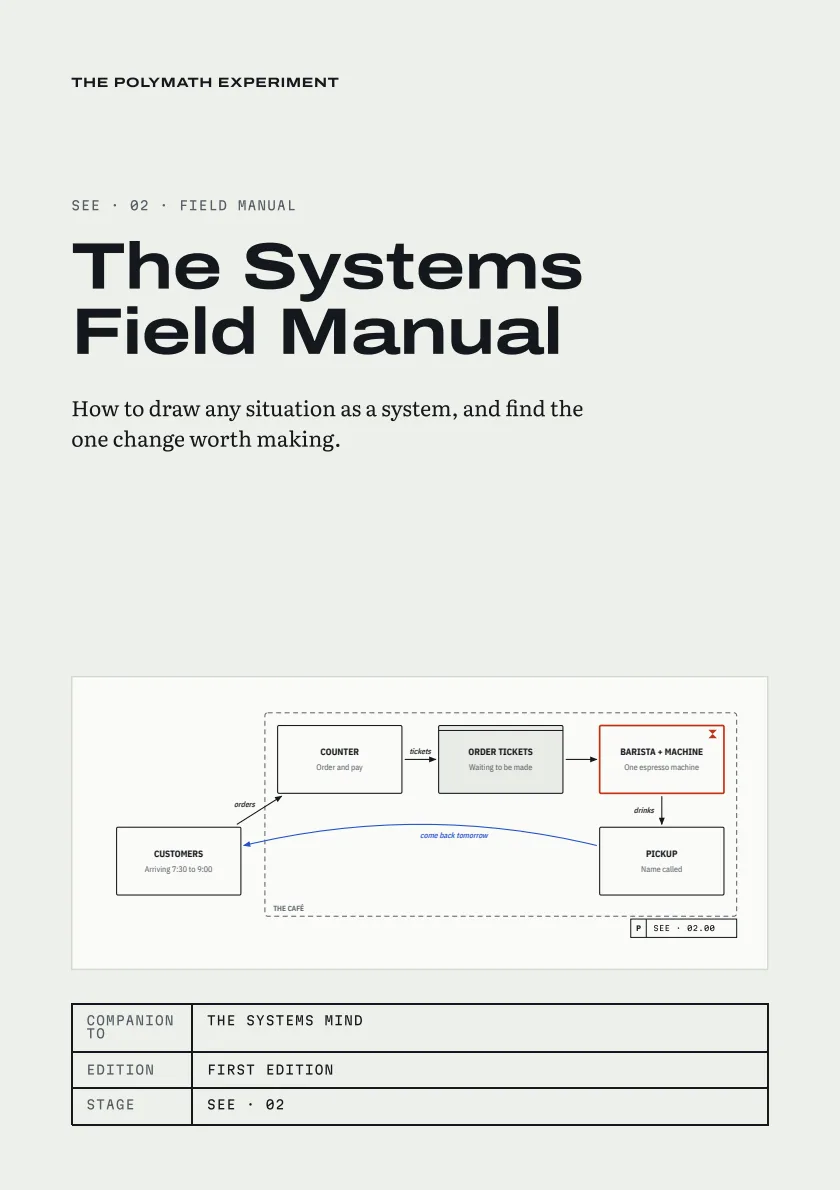
See · 02 · One idea, drawn twice
Draw it as it feels, then as it works
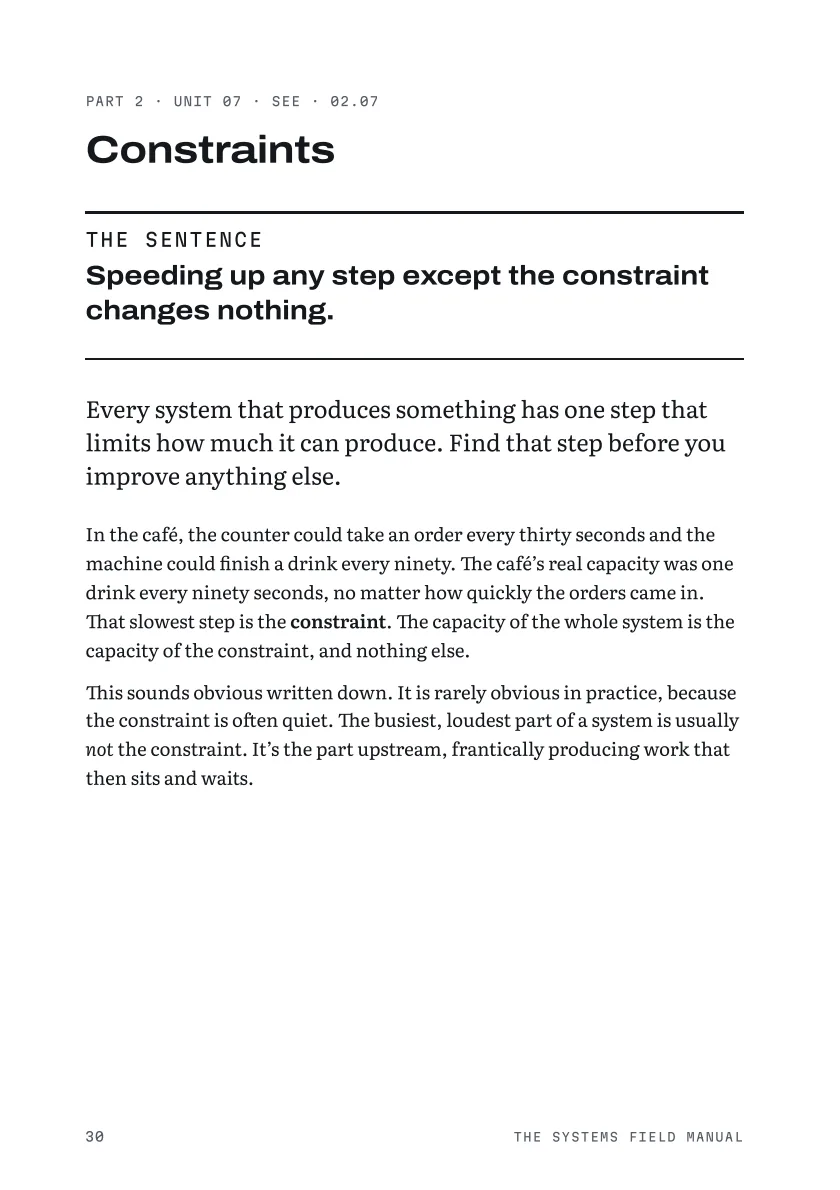
Every unit shows a situation drawn twice, then gives you the canvas to draw your own. Here's the idea behind Unit 07, Constraints, with an everyday example.
The method: draw the system
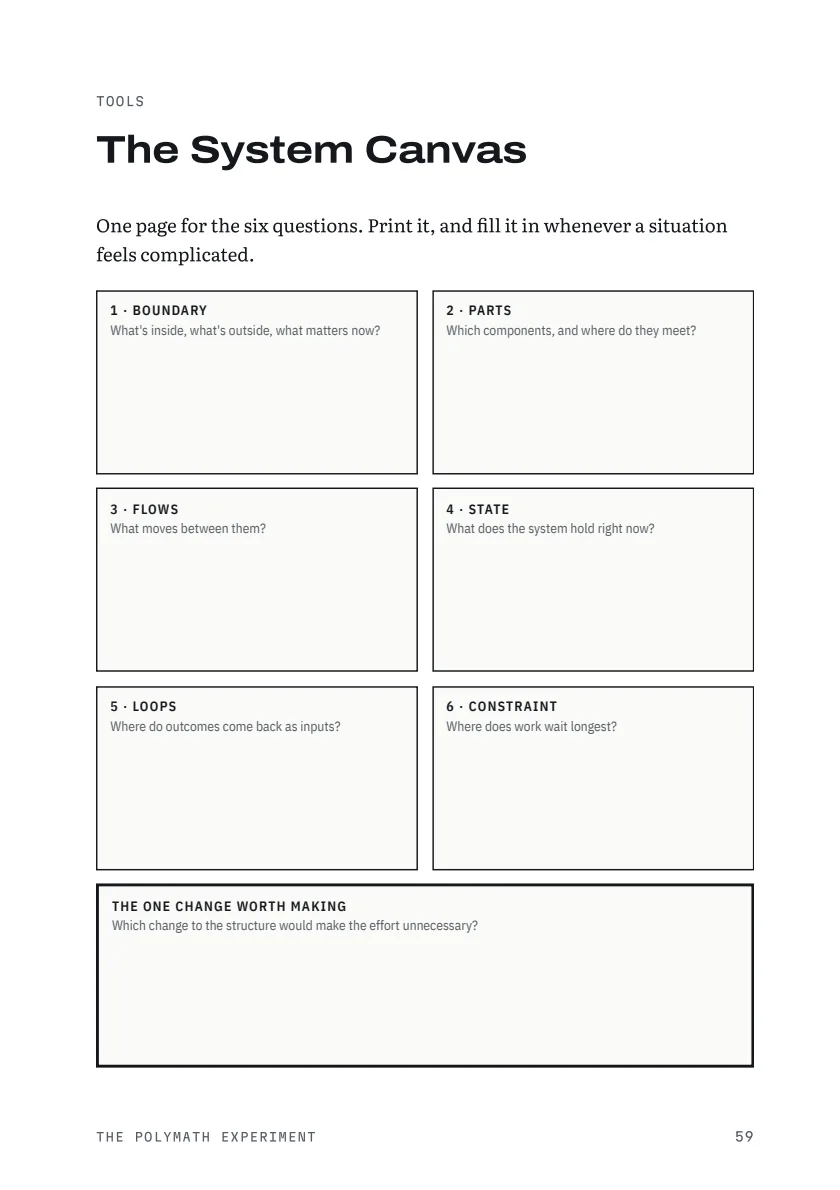
- Where is the boundary? What's inside, what's outside, what matters now?
- What are the parts? Which components, and where do they meet?
- What flows? Information, money, work, attention.
- What is the state? What does the system hold right now?
- Where are the loops? Where do outcomes come back as inputs?
- Where is the constraint? Where does work wait longest?
Three field cases
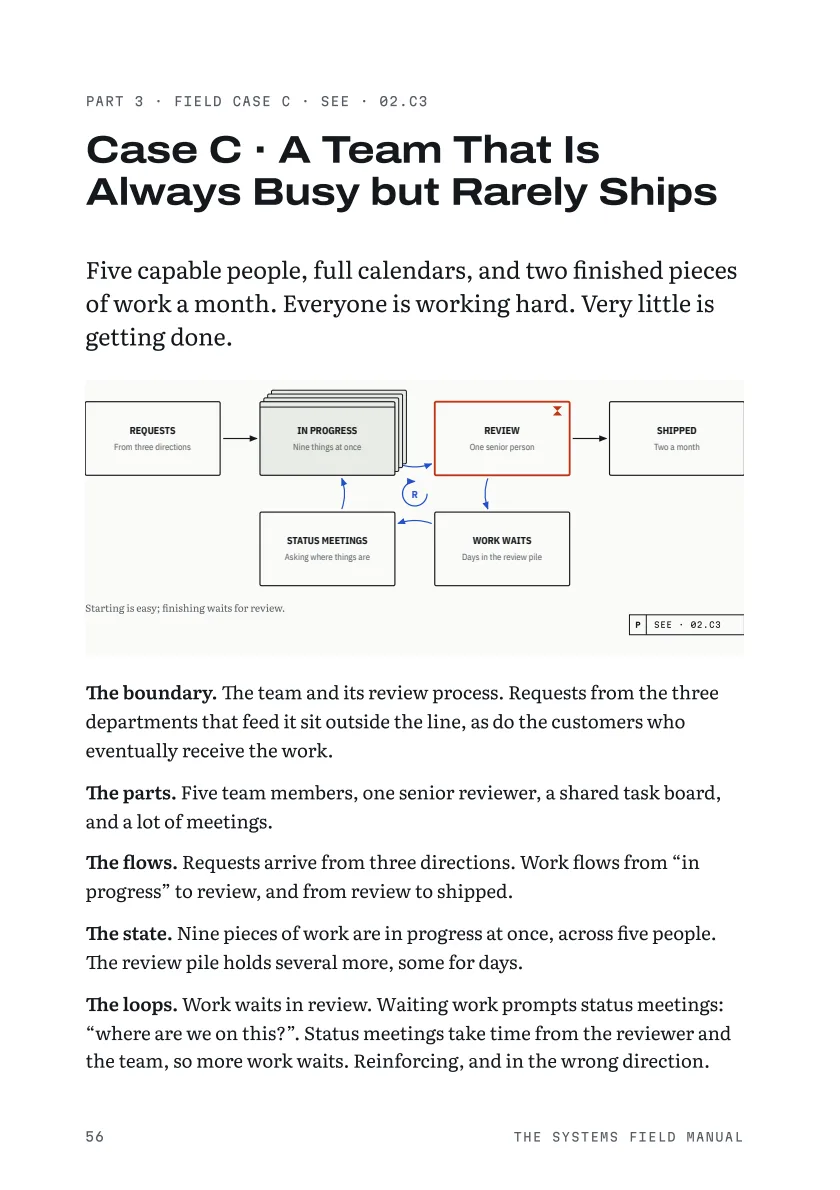
A household week, a small online shop, and a team that is always busy but rarely ships, each drawn from boundary to constraint. Then a printable System Canvas, a quick reference and a glossary.
For the full set of fourteen canvases, one for each unit and more, see The Systems Toolkit.
Eleven units, one sentence each
See · 02.01 – 02.11- 02.01BoundariesEvery system is a choice about what to leave out.
- 02.02Components and interfacesMost problems live where the parts meet, not inside them.
- 02.03FlowsFollow what moves, and the structure appears.
- 02.04StateA system's behavior depends on what it remembers.
- 02.05DependenciesEverything you rely on is a way you can fail.
- 02.06QueuesWork waiting is work invisible, until it starts creating more work.
- 02.07ConstraintsSpeeding up any step except the constraint changes nothing.
- 02.08FeedbackOutcomes come back as inputs, and that's where behavior comes from.
- 02.09Failure modesAsk how it breaks before you ask how to improve it.
- 02.10EmergenceThe whole can do what no part intends.
- 02.11LeverageChange the structure, not the effort.
Inside the PDF
A5 pages · read on screen or print at home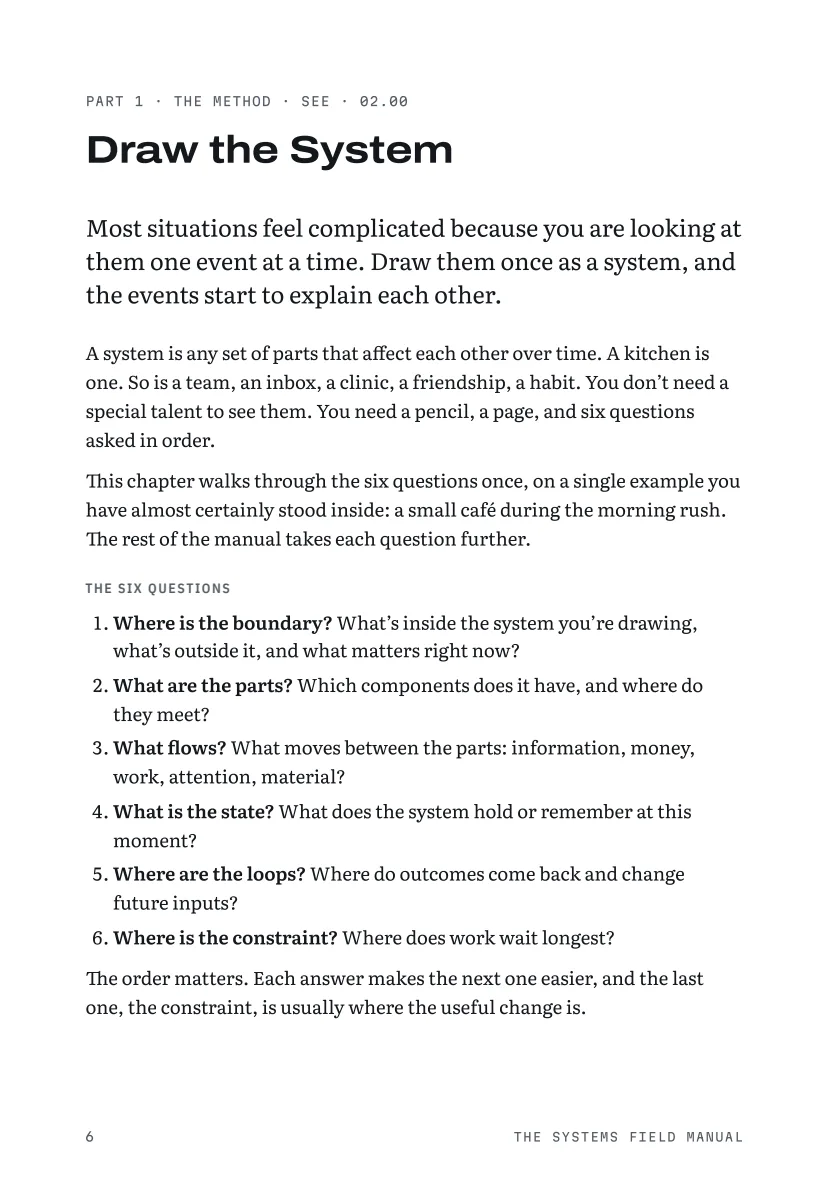
See · 02 · Bundle
The manual and the toolkit, together
The Field Manual teaches each concept; the Toolkit gives you the canvas to use it on. Every canvas carries the same sheet number as its unit, so you can read one and work through the other.
- The Systems Field Manual66 pp · A5
- The Systems Toolkit14 canvases · A4 + Letter
Instant download: all three PDFs. Full refund within 14 days, no questions asked.
The manual and the book
The field manual gives you the tools. The Systems Mind, the full book, explains why systems behave as they do: delays and overshoot, patterns that repeat across very different systems, people inside systems, and how to redesign one rather than just survive it.
Start free
The method grows out of The Polymath Bible, which is free. Get the book and a weekly letter with one idea, one diagram and one exercise.